Electrical Risk in AI Data Centers: Insulation Monitoring and Fault Location in Ungrounded 800V DC Systems
Power Density Is Rewriting the Distribution Architecture
Modern AI training clusters have pushed data center electrical design past the limits of conventional low-voltage AC distribution. Sites once considered large at ~30 MW are now scaling to 10x or greater in a very short timeframe. Racks that drew 10 to 15 kW now draw 200+ kW, and the newest reference designs exceed a megawatt.
Against 400V AC supply, higher-voltage DC removes conversion stages, cuts copper mass substantially, and scales cleanly toward megawatt racks. Open Compute Project and NVIDIA-aligned reference designs have set a common direction. The shift creates a unique challenge, which is previous grounding and protection schemes are no longer applicable for the distributed DC data center.
Why the Ungrounded System Fits AI Loads
AC data center grounding systems tend to favor the mid-point grounding scheme. This allows ground-fault current to flow during a fault; However, it is generally limited by mid-point resistors. This fault current could be large enough to open a breaker or trigger a protection relay. That logic suits relatively simple loads that have minimal impact when their power source is cycled. It suits poorly a coherent GPU cluster representing hundreds of millions of dollars in silicon, and a training run measured in weeks. An architecture that treats every electrical anomaly as a trip signal trades availability for simplicity.
The ungrounded system exists to avoid that trade. No line conductor is intentionally connected to earth in an ungrounded system. When a first insulation fault occurs, there is no low impedance return path, so only a small current flows, determined largely by system leakage capacitance. The upstream overcurrent protective device does not operate during a ground fault condition on an ungrounded system. This major advantage could also be spun as a disadvantage, which is that a ground fault can easily go unnoticed. An undetected or uncleared ground-fault is priming the system for a large-scale failure when a second fault occurs.
Insulation Degradation and the Two-Fault Sequence
Insulation exists to keep current in the conductor. It degrades under heat, humidity, contamination, vibration, ageing, and mechanical damage from installation and maintenance. As it degrades, resistance between the live conductor and earth falls.
The second fault is the failure event. When a second conductor develops its own path to earth while the first remains present, the two faults form a low-impedance circuit across the system and full fault current flows.
The interval between the two faults is the only advance warning the architecture provides. The key to avoiding the second fault scenario is to monitor the real time insulation resistance of the system and take corrective action as soon as possible.

Insulation Monitoring: Bender ISOMETER® Devices
An insulation monitoring device (IMD) is connected between the system and ground. It superimposes a measuring signal on the system, evaluates the returning current, and derives the insulation resistance between the live conductors and earth in real time. When the insulation falls below the configured response value, the device alarms without interrupting supply. One device supervises the entire galvanically connected system, which is generally from the SST down to the rack loads.
Bender ISOMETER® devices apply this method across unearthed DC and AC/DC systems, with variants engineered for the conditions that define AI halls:
- DC IT systems, including the ±400V DC configurations used to build 800V DC distribution.
- High system leakage capacitance, so significant amounts of parallel power supplies do not drive nuisance alarms or extend measurement time beyond usefulness.
- Coupled systems (diodes, transfer switches, etc), where the ISOnet function coordinates multiple IMDs so devices in interconnected sections measure in sequence rather than interfering with one another.
Response values deserve explicit attention at design time. Set too low, the alarm arrives with little margin before a second fault becomes likely. Set too high, it produces alarms operators learn to ignore or does allow fault location equipment to operate properly.
Insulation Fault Location: Finding the Fault Without De-Energizing
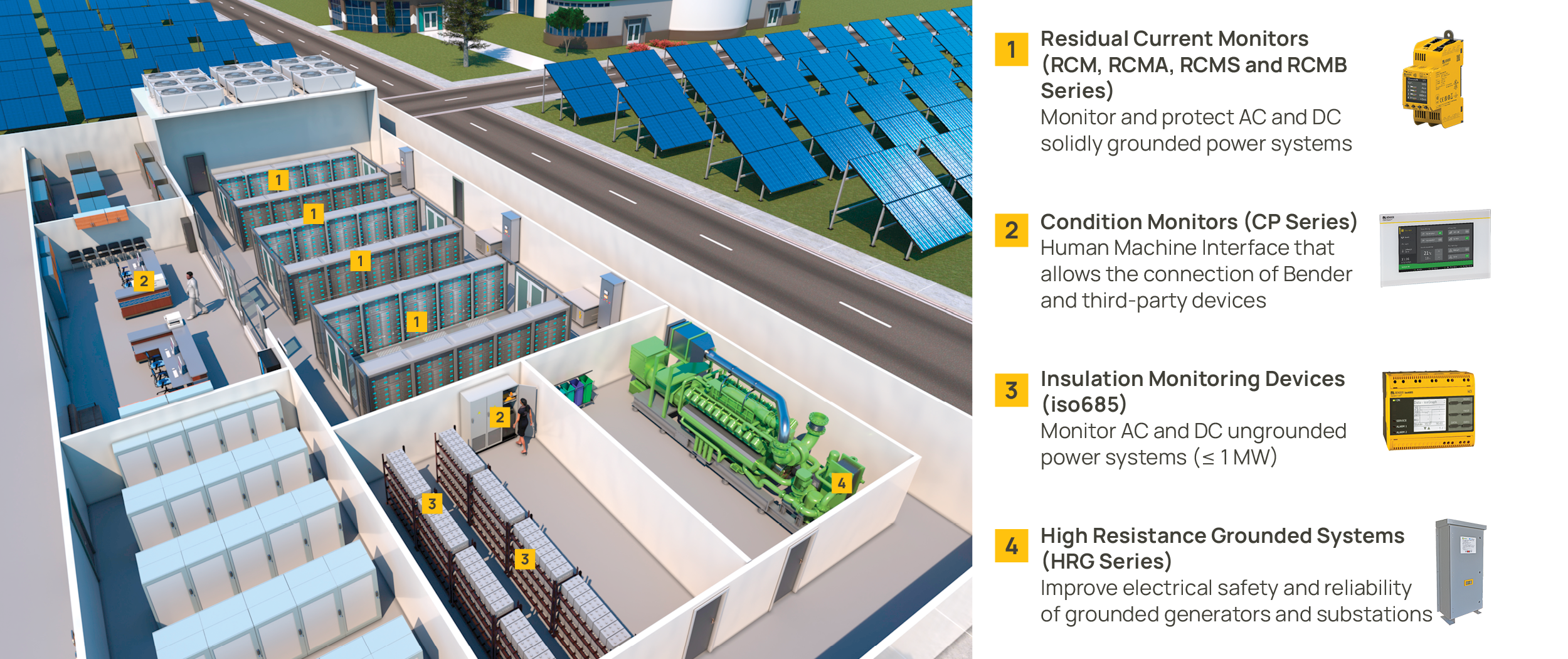
Detection answers whether the system has a fault. In a hall with hundreds of branch circuits, the operational question is which circuit has the fault when my IMD indicates a low insultaion resistance condition? Without that answer, the response is a manual sectionalizing hunt which frequently is accomplished with cycling load breakers. That is exactly the disruptive activity the ungrounded system was adopted to avoid, and in an AI facility it is not an available option.
Bender insulation fault location (EDS) systems identify the fault to a specific outgoing circuit while the installation stays energized. The method is deterministic:
- The ISOMETER® iso685-x-P includes a locating current injector.
- That current flows through the faulted conductor, the insulation fault, and the PE conductor, back to the injector.
- ISOSCAN® EDS insulation fault evaluators, using measuring current transformers on each monitored circuit to detect which channel carries the pulse pattern.
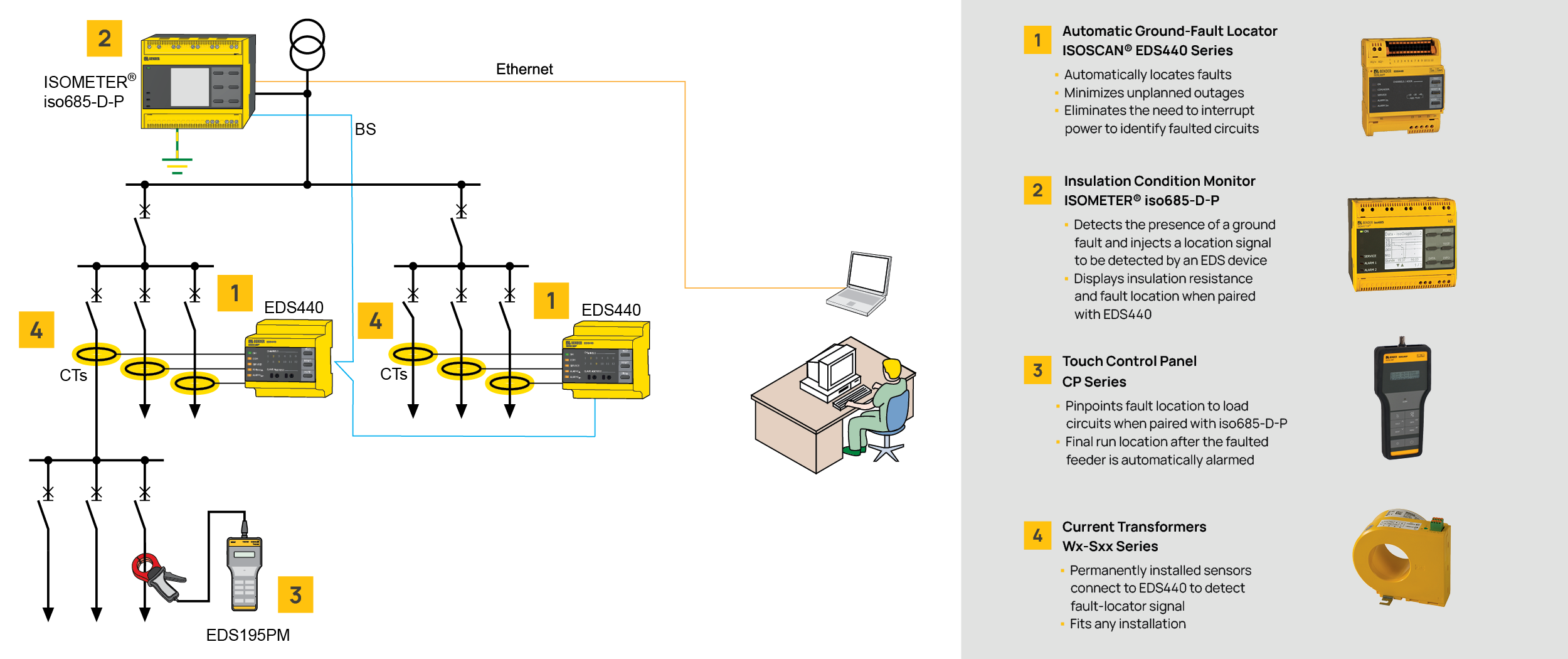
One iso685-D-P supports up to 50 EDS devices, and all EDS44x channel parameters are configured from the ISOMETER® web server. In coupled systems, the EDSsync function runs fault location simultaneously on both sides of a coupling switch, so a bus tie configuration does not create a blind zone. Where permanent instrumentation does not extend into sub-distribution, portable EDS equipment locates faults in secondary circuits without disconnecting the installation.
The design consequence is significant for AI facilities. Fault location converts a first fault from a hall-level alarm into a work order against an identified circuit, with no shutdown, no sectionalizing, and no interruption to a training run. It also exposes recurring weak points in the installation, which could be a particular busway section, a specific rack lineup, a repeatedly disturbed cable route, etc.
Operational and Financial Consequences
In an AI facility, electrical failures propagate beyond the affected lineup. An unplanned outage can destroy a training run and force a restart from the last checkpoint, consuming compute hours scheduled months in advance. A developed DC fault can damage power supplies, busway, and conversion equipment with long procurement lead times. In more extreme cases, heat at a compromised insulation path introduces fire risk in a densely packed hall.
The repair itself is rarely the largest cost. Emergency response diverts staff from planned commissioning, service-level credits are issued, and insurance and AHJ reviews become more difficult. In tightly coupled clusters, a single electrical event can cascade into workload failures well beyond the equipment involved. Emergency, unscheduled work performed under pressure is the most expensive maintenance category a facility can run.
Integrating Measurement into Facility Operations
There are many critical parameters in a data center that are continuously monitored and reported. For example, air temperature is measured at the server inlets, humidity is tracked, coolant quality and levels are measured, flow rate and pressure are detected, etc. Electrical protection often remains pass/fail, with periodic inspection substituting for measurement. Periodic insulation testing requires the installation to be de-energized, which in an AI hall means it effectively does not happen.
Bender devices close the gap at the data layer as well as the measurement layer. Modbus TCP and RTU, integrated web servers, and analog outputs deliver insulation resistance and fault location results into DCIM, BMS, and SCADA platforms as live, tenable points rather than inspection records. That enables three things that periodic testing cannot: alarm on drift before threshold violation, intervention scheduled around workload, and defensible measurement data for design review, commissioning, and audit. Automated logging also replaces documentation labor that otherwise scales with every additional hall.
Key Takeaways
800V DC distribution delivers efficiency, copper, and scalability gains, and introduces fault behavior legacy AC protection was not designed to address.
The ungrounded 800V DC system tolerates a first insulation fault without tripping, which is its advantage and, unmeasured, its exposure.
The second fault creates the failure event.
ISOMETER® devices measure insulation resistance continuously and must be specified for DC operation and high system leakage capacitance.
ISOSCAN® EDS fault location identifies the faulted circuit while the installation stays energized, turning an alarm into a scheduled work order.
Engineered for Resilience
The 800V DC transition will proceed on an aggressive schedule. The operators who manage it best will not be the ones who purchased the most redundancy, but the ones who specified insulation visibility at design time.
Bender has engineered electrical safety for ungrounded systems for more than 80 years, in environments where unplanned shutdown is unacceptable: hospitals, industrial process plants, rail, marine, and data centers. The ISOMETER® and ISOSCAN® platforms bring that measurement experience to 800V DC architectures now being deployed faster than the industry's collective operating experience with them is accumulating. Resilience in AI infrastructure is either built in at design time or paid for at failure time.
Contact Bender to learn how insulation monitoring and fault location can support your facility’s electrical safety and reliability.
Our commitment to innovation and excellence drives us to create solutions that exceed expectations. When it comes to protecting your facility, trust the experts. Trust Bender.
For more information about this application or to learn more about Bender technology related to your specific application, contact our team of experts.