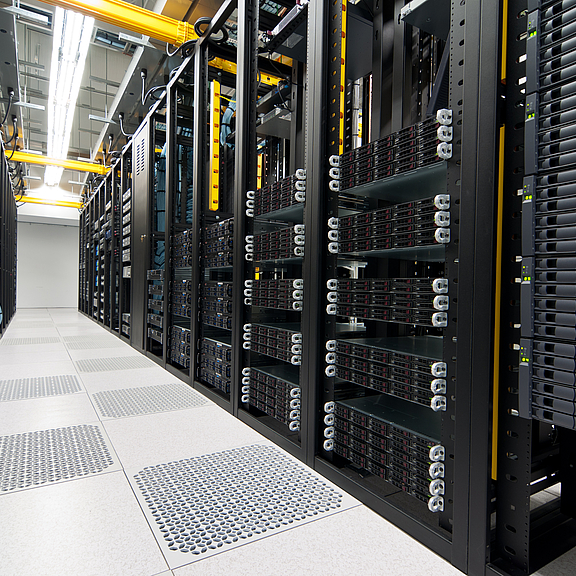
An 800 V dc data center architecture distributes power at approximately 800 volts direct current to support high-density AI computing. Compared with lower-voltage distribution, higher-voltage dc can transmit more power at lower current, reducing conductor and copper requirements. OCP describes both a near-term side-power-rack approach that converts 480 V ac to either +/-400 V dc or 0-800 V dc and a longer-term architecture that converts medium-voltage ac directly to 800 V dc using solid state transformers (SSTs).
Need an architecture review? Share the grounding concept, one-line diagram, voltage arrangement, coupled sections, and planned rack distribution.
The Open Compute Project, or OCP, is a collaborative community that develops open infrastructure specifications and designs for data centers. OCP work on low-voltage dc power distribution includes common 800 V dc interfaces, conversion architectures, grounding, protection, energy storage, and system integration. Google, Microsoft, NVIDIA, and other ecosystem participants are contributing to this work.
Bender’s membership supports participation in the industry discussion around next-generation data center infrastructure.
The monitoring method depends on how the 800 V dc system is referenced to ground. Select the monitoring approach to match the grounding arrangement, then coordinate detection, alarms, and protection across the connected distribution system.
In an ungrounded, or floating, system, an insulation monitoring device continuously measures resistance between active conductors and ground.
Continuous insulation monitoring, with automatic fault location where affected branches need to be identified.
In a resistance-grounded system, monitoring supervises the grounding resistance and fault current to identify resistance changes (including opens and shorts) that impact the protection of the system.
Continuous neutral grounding resistor continuity monitoring, monitoring of harmonics through the NGR and fault location with sensitive full frequency responding UL1053 listed ground-fault relays. Can provide selective co-ordination or fault location in alarm only applications.
Use an insulation monitoring device to continuously measure resistance between active conductors and ground. The Bender ISOMETER® iso685 Series is designed for ungrounded ac, dc, and power-conversion systems, with a nominal system voltage range of up to 1000 V dc. The current UL application rating is ac/dc 0 to 600 V. The iso685 continuously monitors insulation resistance and provides measured values through its display, built-in web server, Modbus/TCP communications, relay contacts, and analog output.
Grounded systems typically use current transformer based fault protection. The grounding resistors must be continuously monitored to ensure there is a return path for the fault current. Bender NGRM500 / NGRM700 for 800 VDC or ±400 VDC systems continuously monitor the ground path resistance. Bender current sensors, such as the CTUB10x-CTBCxx series, can be used on the NGR and and branch feeders to detect and locate very low level ground faults across a wide frequency range including dc.
Yes. When the iso685 fault-location variant is paired with ISOSCAN® EDS440 Series modules and one measuring current transformer per monitored branch, the system can automatically identify the affected circuit while the installation remains online. Each EDS440 module monitors up to twelve channels in parallel, and additional modules can be interconnected when more branches must be monitored.
Establish the fault-location requirements by documenting the upstream and downstream circuit topology, conductor dimensions, CT opening requirements, possible bus-coupling configurations, and circuits to be monitored for automatic fault location.
Use neutral grounding resistor monitoring to verify that the grounding resistance remains within its intended condition and to measure fault current. Bender’s 800 V dc NGR application note identifies NGRM500 and NGRM700 monitoring for 800 V dc or ±400 V dc systems. The documented solution continuously monitors resistance value and fault current and detects deviations from the setpoint. Bender NGR packages complete with NGRM500 or NGRM700 monitoring are the only systems known to provide full frequency measurement of voltage and current of the grounding resistors.
View Bender resistance-grounded system solutions
To validate the grounding path, review the NGR arrangement, resistance value, fault-current measurement, alarm handling, system integration, and maintenance approach.
Electrical monitoring extends beyond the 800 V dc bus. Different parts of a data center require monitoring methods suited to their grounding arrangement and electrical topology.
Use continuous insulation monitoring and, where needed, automatic branch-circuit fault location.
Explore this applicationMap monitoring to the distribution zones that operators need to troubleshoot without unnecessary disconnection.
Explore this applicationMonitor grounded UPS inputs, outputs, bypass paths, and downstream distribution according to the actual topology and frequencies present.
Explore this applicationUse residual-current monitoring on grounded ac distribution to detect low-level leakage and fault currents before they become more serious.
Explore this applicationChoose insulation or residual-current monitoring according to whether each monitored section is ungrounded or grounded and according to the converter topology.
Explore this applicationApply the appropriate grounding and monitoring concept to emergency and standby generator systems. HRG and LRG solutions are commonly used as generator grounding methods to limit fault current to protect the generator while still allowing enough current to trip protection devices.
Explore this applicationMonitoring data from an 800 V dc electrical system can be integrated into Data Center Infrastructure Management (DCIM), Building Management Systems (BMS), and Supervisory Control and Data Acquisition (SCADA) systems. These platforms can use electrical monitoring data to provide greater visibility into system status, alarms, and electrical conditions.
The iso685 Series and NGRM devices offer a built-in web server, Modbus/TCP, relay contacts, and analog outputs. The final integration design should define which measurements, alarms, events, and status points are required by the facility platform and who owns the response workflow.
Before commissioning, define the point list, protocol, alarm priorities, event history, network ownership, and operational response for each alarm.
OCP stands for the Open Compute Project, a collaborative community that develops open infrastructure designs and specifications for data centers.
Yes. Bender is a Bronze Member of the Open Compute Project.
No. OCP materials discuss 800 V dc architectures that may use an IT floating arrangement or high-resistance grounding. The monitoring method must match the selected grounding architecture.
The Bender ISOMETER® iso685 Series measures insulation resistance in ungrounded ac and dc systems and connects directly to systems up to 1000 V dc.
An iso685 fault-location variant can work with ISOSCAN® EDS440 modules and measuring current transformers to identify the affected circuit while the system remains online. Selective tripping can be accomplished with the addition of the IOM441 module.
Bender’s 800 V dc NGR application note identifies NGRM500/700 monitoring for 800 V dc or +/-400 V dc systems.
An insulation monitoring device measures insulation resistance in an ungrounded system. An NGR monitor supervises the grounding resistance and fault current in a resistance-grounded system.
Use the application review to submit the grounding concept, one-line diagram, system voltage, monitored branches, communication requirements, and certification needs.
An AI factory is a high-performance computing environment built to transform data into AI-driven insights and applications. It supports the complete AI process, from developing and training models to running AI workloads at scale.
Bender is a global leader in electrical safety. Our intelligent monitoring solutions help protect people, equipment, and critical systems while supporting reliable power availability across industries. From electric mobility and charging infrastructure to industrial systems, healthcare, data centers, and renewable energy, Bender helps customers identify electrical faults early and keep essential systems operating safely.
Ready to discuss your application? Contact Bender to connect with an electrical safety specialist.