A neutral grounding resistor, or NGR, is installed between the neutral point of a transformer or generator and ground. It limits the amount of current that can flow during a line-to-ground fault, helping reduce equipment damage while allowing protective and monitoring devices to detect the fault.
An open, shorted, damaged, or improperly connected NGR can prevent a resistance-grounded system from operating as intended. Continuous monitoring can detect changes in resistance, loss of continuity, ground faults, and abnormal current or voltage conditions so maintenance teams can respond before the problem leads to equipment damage or an unplanned outage.
Bender’s NGR monitors can evaluate current through the resistor, voltage between the neutral point and ground, and the condition of the NGR and its connections.
Neutral grounding resistors are used in both high-resistance grounded and low-resistance grounded power systems.
In a high-resistance grounded system, the NGR limits ground-fault current to a low level. This can allow the system to continue operating temporarily after the first ground fault while monitoring equipment provides an alarm and helps personnel locate the fault.
In a low-resistance grounded system, the NGR permits a higher level of ground-fault current so protective relays can detect the fault and disconnect the affected circuit quickly. LRG systems are commonly used where controlled fault current and rapid isolation are more important than continued operation after the first fault.
The primary difference is the amount of ground-fault current permitted by the neutral grounding resistor. HRG systems limit current to a relatively low level and may allow continued operation after the first fault. LRG systems permit more fault current so protective devices can identify and disconnect the faulted circuit.
Actual resistor ratings and protection settings must be selected for the system voltage, available fault current, equipment configuration, and applicable electrical requirements.
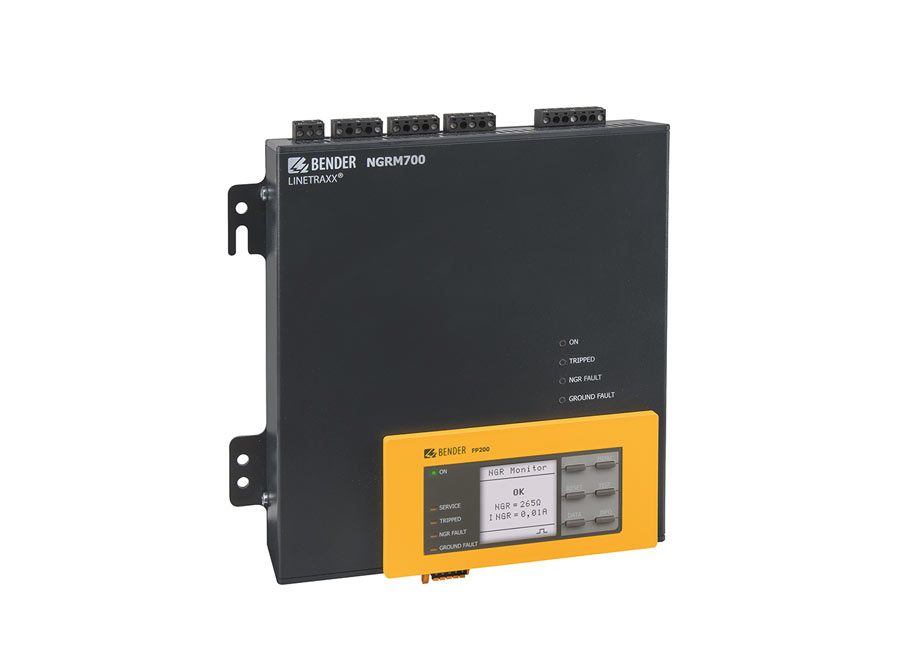
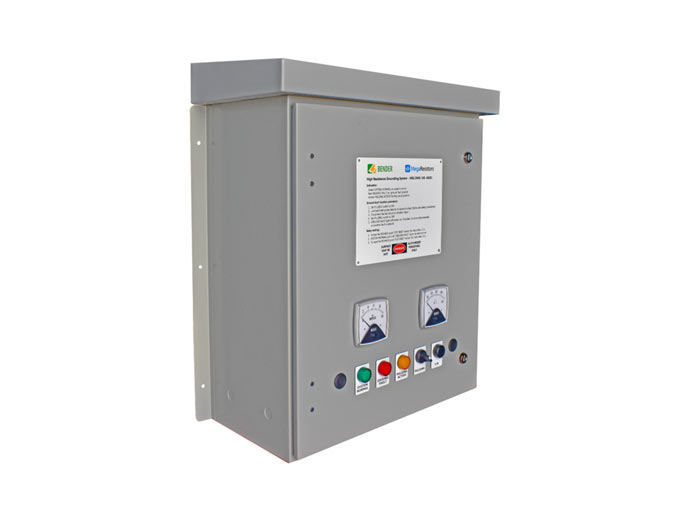
Bender offers high-resistance and low-resistance grounding solutions for transformers and generators in commercial and industrial power systems. Available solutions include complete HRG packages and LINETRAXX neutral grounding resistor monitors that detect ground faults and problems with the NGR or its connections.
The LINETRAXX NGRM700 is intended for high-resistance grounded systems, while the NGRM750 is intended for low-resistance grounded systems. Monitoring options can include NGR current, neutral-to-ground voltage, resistor condition, line voltage, alarm history, and communications for local or remote diagnostics.

Like any mechanical device, grounding resistors can fail due to age, vibration, corrosion, and other external causes such as lightning. The ground-fault protection on grounded systems is typically current transformer (CT) based and requires a return path to the source in order for current to flow.
NGRs are often mounted outdoors near the main power transformer feeding a facility. They can be even more remote on a moveable substation. Communications to these devices provide valuable diagnostic information that customers can access at their desk or even on a mobile device.
In more advanced NGR systems, the relays will provide the level of fault current, the frequency of the fault current, and the phase that the fault is appearing on. If the systems are also equipped with downstream ground-fault protection, they will direct you to the correct feeder, MCC, or even load that has the fault.